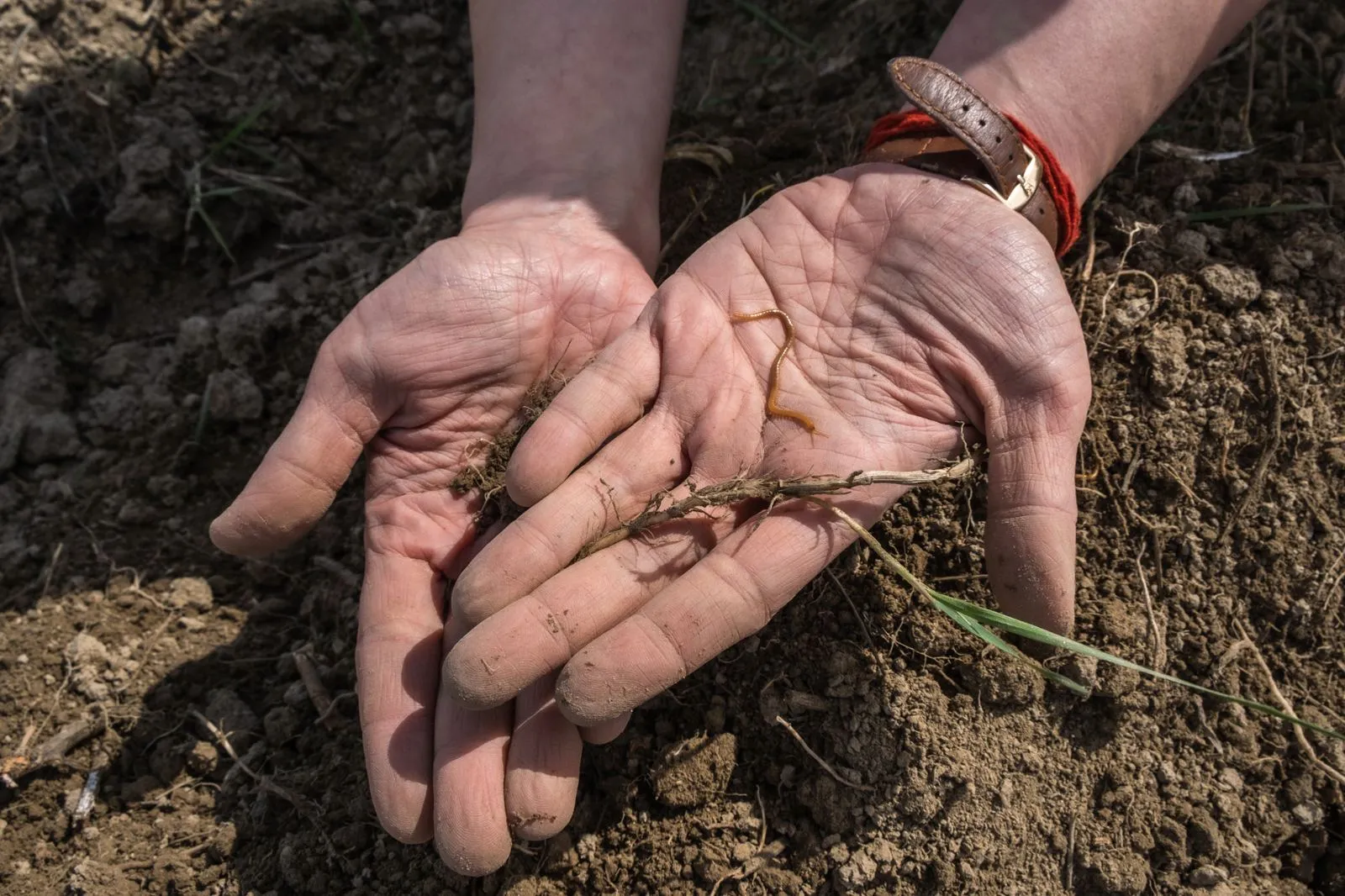
We claim the arm is better for the soil than a plough. You don’t have to take our word for it – scientists from the National Agricultural and Food Centre (NPPC) studied the soil in Agrokruh. They found the most healthy, crumbly structure of all the soils compared.
Who studied what
The research was carried out by Beata Houšková, Katarína Nováková and Vladimír Píš from the Soil Science and Conservation Research Institute (NPPC – VÚPOP) in Bratislava. They compared three soils: soil in Agrokruh circles, conventionally tilled soil (ploughed), and soil under a meadow as a control. Samples were taken at three depths, from the surface down to 60 cm.
The most healthy structure at every depth
The key result concerns so-called agronomically valuable structure. These are small, stable soil crumbs that don’t fall apart after rain. Water and air are held between them and roots grow through them easily. The more such crumbs, the more alive and fertile the soil.
Soil from Agrokruh had the highest share of agronomically valuable structure at all depths studied. The biggest difference was at 20 to 40 cm – exactly where ploughing affects conventionally tilled soil the most.
Values are read from a chart in the original report, so they are approximate.
What ploughing does to soil
At 20 to 40 cm, ploughed soil had the most tiny micro-aggregates smaller than 0.25 mm. According to the authors, this indicates its crumbs are less stable in water. This is partly due to a different soil composition, but it can also be attributed to ploughing, whose effect is strongest at this depth.
Nutrients without synthetic fertilisers
No synthetic fertilisers are used in Agrokruh. Even so, according to the research, the nutrient content is at a level that covers the needs of the crops grown. In the top layer, Agrokruh soil had the most humus and phosphorus:
| Soil | Humus (%) | Phosphorus P (mg/kg) | Potassium K (mg/kg) |
|---|---|---|---|
| Agrokruh | 4.29 | 55.3 | 209 |
| Meadow (control) | 3.55 | 3.82 | 231 |
| Conventional tillage | 3.45 | 19.6 | 90.4 |
What about compaction
According to the research, all three soils have favourable physical properties and hold water well. Water doesn’t pool on them after rain. Agrokruh soil is slightly compacted at 35 to 40 cm, which the authors say poses no risk to the crops. For these physical properties, no differences between tillage methods were confirmed – the soils studied are fairly resistant to compaction.
Conclusion of the research
“The positive effect of tillage on Agrokruh was fully reflected in the content of agronomically valuable structure. Over time, an increasing effect of agronomically valuable structure on other soil properties and on the soil’s water retention capacity can be expected.”
Source: Houšková, B., Nováková, K., Píš, V.: Vplyv alternatívnych spôsobov obrábania na pôdne vlastnosti (The effect of alternative tillage methods on soil properties). NPPC – Soil Science and Conservation Research Institute, Bratislava, 2015.
Leave a Reply